

A Sovereign Home
Bringing back the productive household, and down with outsourcing to 'experts'

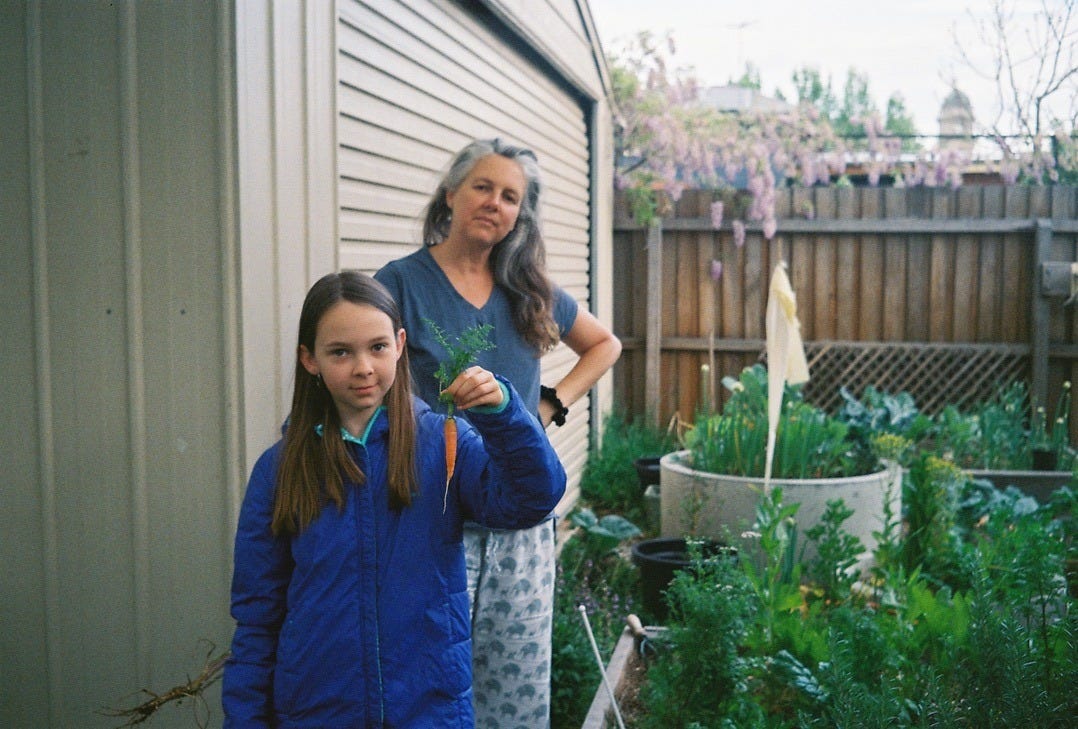
I work a lot — and I don’t get paid for it.
In other words, I work at home. There is no Big Boss. I do all the housework and most of the cooking, I work our garden, I run the household. Yet somehow, all that work is deeply undervalued — not by me or my husband, but by society generally.
Over many decades, there’s been a gradual shift away from home-based work. Slowly but steadily, we have outsourced one thing after another — and now, we find ourselves no longer in control of our own food production, food preparation and cooking, childcare, child rearing, education, work, exercise, and even personal development (hello, therapy culture). All these life areas have been delegated to their respective ‘proper institutions’. And our homes are empty shadows of what homes once were.
So when did we slide away from wholeness and productivity in our own homes, and start shelling out our sovereignty to the institutions it supposedly ‘belongs to’?
I work part-time. The other days of the week I spend doing things that are valuable, but not directly financially so. I am a wife and I cook. I also tend to our land, of which there is an acre, on which there are vegetable gardens, my little flower patch, an orchard and a cottage garden containing various edible and medicinal plants. This means we eat a good deal of fresh home-grown produce. I care for our chickens, who do garden work for me and gift us eggs. I care for our cats, who keep the rats and mice away. I do all the housework. I orchestrate our weekly menu and grocery shop. I keep the household running.
What price tag can you put on all that? None of it pays financially, or at least directly so. I won’t bother to calculate how much money my home-work saves my husband and I, but I’m sure it’s not nothing. More than that though, we benefit from retaining some of our sovereignty: over our land, over our health and bodies, over our time, over our food. That’s where the real value lies.


Our culture loves to defer to ‘experts’. Headlines including the words ‘experts say…’ probably get ten times more clicks — because great knowledge is understandably appealing. We do collectively have a genuine curiosity to know more, and to know things that are of value. Yet not all experts have our best interests at heart. There are ‘baby sleep experts’ who will tell you an infant needs to ‘learn how to regulate’ and can do so if you leave them to cry for hours alone in a dark room. There are ‘agricultural experts’ who will recommend the use of glyphosate and other toxic substances which kill all soil life in the name of convenience. There are ‘mental health experts’ who will recommend a lifetime of pill-popping; and my favourite: there are ‘skin experts’ who will recommend you slather yourself in carcinogenic sunscreen to block any goodness the sun might dare to shine into you. Of course, some experts are wonderful. Yet so often I have found that the people telling you what to do are the ones you should ignore.
Regardless of their truth or untruth, the unfortunate consequence of this constant hailing of ‘expert opinions’ is that we are leaning ever-further towards devaluing personal experience and relegating ‘anecdotal evidence’ to the realm of the stupid. There may come a time where we realise that our grandparents’ lore is often more practically useful than the newest ultra-niche PhD research paper. Until then, we will continue to give away our sovereignty — and our rights — based on the pure convenience of outsourcing to those who ‘know best’.
So what does this have to do with the humble household? Everything! I think we all have a deep intrinsic longing for ‘the real’ in our hearts. I felt the real this morning when I sowed corn seeds for a summer harvest. I felt the real when my friend taught me how to graft fruit trees. I feel the real when I hang out the washing, and I feel the real when I pray, because that’s me and Jesus and there is absolutely no middleman. The real exists in our humble spheres of no influence — where we do things ourselves, for no extrinsic body besides ourselves and our inner circles (friends, family, neighbours). The best place for cultivating the real, or authenticity, is the home. And an authentic or sovereign household is a productive one. It produces love and stability (and eggs and knitted socks and firewood and vegetables).
My household is my control centre for defence against a toxic world. The mission is health and wholeness, and the means is independent capability and sovereignty.
Of course, I must spend a paragraph here clarifying that this is not purely a ‘women’s issue’, and I am not trying to be ‘regressive’. This is an everyone issue. Women’s ‘emancipation’ from the home is a significant part of the problem, though: The mindset cultivated by today’s pervasive feminist doctrine that home-work is to be devalued, and is degrading to women, is probably why we are in this situation to begin with.
Regardless of the cause, the cure must be unifying. Both women and men have to act to change the anti-home culture. Men need to become more capable providers; not just financially, but by swapping pointless sports-spectating for firewood collecting, building, home maintenance, and being present and active fathers. Women need to have a mindset shift and realise housework can be an act of love, cooking can be an art, and mothering is irreplaceable. The home is not just a place for women and children; it is a place for the whole (nuclear) family. And that is good.
Small note here to say that not all gender roles are good, blah blah blah, caveats upon caveats. My husband likes cooking too, and I like building stuff. That is good too.
All this is what being ‘naturally radical’ means (at least to me). Doing things naturally has become radical, though it never used to be. Home-based lifestyle choices like homeschooling, home-birthing and homesteading these days are stigmatised as abnormal, yet before modern educational institutions, medicalised birth and mass-scale agriculture were established as the standard, these things were normal and natural.
Grass lawns first became a thing because they were a statement to onlookers that the landowner was rich enough to afford not to grow any of his own food or medicine. It’s been a slippery slope from then! These days, I think we are finally realising that we have taken the outsourcing too far, and wondering why we feel so disconnected from/in our own lives.
What I have come to realise is this: Selling out and shelling out our own productivity to the (primarily economically/financially-driven) machine in the name of convenience is not satisfying in the way that meaningful work is satisfying. Buying a bag of frozen peas isn’t half as satisfying as growing and shelling peas from your own garden — even though the former is much easier and quicker. Working two jobs so you can send your children to childcare doesn’t give you the satisfaction of raising them. Life is harder when we do things ourselves, but it is more meaningful. Though it may cost you in loss of earnings, or loss of ‘free’ time, or even judgement from your silly modernity-loving friends, it is a thousand times more meaningful to retain authority over your household, family and land.
That’s all for now. If you aren’t already following, I post about what we do on our little semi-homestead over on Instagram at @beaufort.sovereigngrowers, and would love to see you there!
Thanks for reading. Whether you agree or not, I’d love to hear your thoughts in a comment! :)
We have been having many conversations about this - and have started diving into this book called “Matrimony “Ritual Culture and the hearts work” by Stephen Jenkinson - not sure if you’re familiar with his writing - anyway it’s interesting the history about the long road to here, and thinking about how we might reclaim it all…..
Big love from over here at the Seaview Zoo xx
Love how you live… and write.